Friday, 14 September 2007
Late notice: Waterfall 2006 conference on Project Management
Here's an important conference which unfortunately I missed last year. But no matter - the content is timeless, so no doubt it will be held over and over again with exactly the same presentations.

Thursday, 13 September 2007
Quote of the day - C. A. R. Hoare
There are two ways of constructing a software design: One way is to make it so simple that there are obviously no deficiencies, and the other way is to make it so complicated that there are no obvious deficiencies. The first method is far more difficult.
- C. A. R. Hoare
- C. A. R. Hoare
Geodetic data in PostGIS - Spherical indexing schemes
Here at Refractions we're starting to think about how we can provide better support in PostGIS for geodetic data. Geodetic data is data which is defined in a true spherical coordinate system (in particular, of course, the surface of the Earth).
Currently PostGIS provides some geodetic-aware functions (such as distance between two geodetic points). But it's current spatial data model is fundamentally planar, so there are definite limitations to modelling geodetic data (e.g. such as the notorious "line crossing the Date Line" problem). As PostGIS gets used for larger datasets and more ambitious projects, the utility of having a full-function geodetic data model is becoming increasingly obvious.
Handling geodetic data in a correct and efficient way presents quite a few challenges. A major one is: how can geodetic geometry be spatially indexed? Conventional spatial indexes (such as 2D R-trees) all rely on geometry being embedded in a planar space. They don't handle data which can "wrap around", as can occur in a spherical space.
There have been various clever proposals for spherical indexing strategies. Some prominent ones are listed below:
Currently PostGIS provides some geodetic-aware functions (such as distance between two geodetic points). But it's current spatial data model is fundamentally planar, so there are definite limitations to modelling geodetic data (e.g. such as the notorious "line crossing the Date Line" problem). As PostGIS gets used for larger datasets and more ambitious projects, the utility of having a full-function geodetic data model is becoming increasingly obvious.
Handling geodetic data in a correct and efficient way presents quite a few challenges. A major one is: how can geodetic geometry be spatially indexed? Conventional spatial indexes (such as 2D R-trees) all rely on geometry being embedded in a planar space. They don't handle data which can "wrap around", as can occur in a spherical space.
There have been various clever proposals for spherical indexing strategies. Some prominent ones are listed below:
- Hierarchical Triangular Mesh - this is essentially a "quad-tree for the sphere". It has a lot of appeal for use with point data, since it provides a hierarchical key which can be indexed using a conventional B-tree index. (It was co-developed by the late, great Jim Gray in order to index astronomical data). The mathematics to determine the index key for a non-point object would seem to be somewhat complicated. It also seems like HTM would suffer from the usual disadvantage of quadtrees of not being very self-tuning. Another disadvantage from the PostGIS point of view is that this would likely be a brand new index type (i.e. lots of difficult code to write)
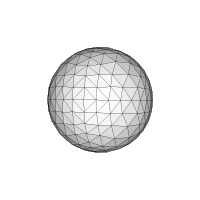
- Hipparchus Voronoi-based index. This index can be thought of as a fixed-grid index using a custom Voronoi cell coverage for the globe. IBM's DB/2 Geodetic extension uses this scheme. I must say that this concept, while ingenious, seems a bit baroque to me. This index has the usual disadvantage of fixed-grid indexes of not handling widely-varying data sizes well. And it also requires extremely complex cell coverage structures, which have to be selected specifically for the expected data composition. DB/2 supplies 13 different ones based on various data densities (G7 industrial output, anyone?). I'm not sure what you are supposed to do if your data has some other density distribution - it doesn't seem very feasible to make your own Voronoi grid. And what if you don't know your data distribution, or it changes over time?

- 3D Bounding Box - this is the approach used by the pgSphere project. It's pretty straightforward. The key concept is to embed the sphere in 3-space, so that it is possible to compute 3D bounding boxes for geometries on the embedded sphere. The bounding boxes can then be indexed using a 3D R-tree (exactly analogous to a 2D R-tree spatial index). The GIST index supplied with PostgreSQL can be customized to provide the required 3D R-tree. One possible issue is that apparently R-trees become "less effective" in higher-dimensional spaces. It remains to be seen whether this is truly a serious problem.
Thursday, 6 September 2007
If REST and WS-* are at war, which one are they fighting?
Ted Nedward has another great post providing lessons about technical, political and historical issues all at the same time.
Let's just hope it isn't the Hundred Years War instead...
Let's just hope it isn't the Hundred Years War instead...
Tuesday, 4 September 2007
Grokking hierarchical queries in Oracle
Oracle provides a very powerful SQL extension to evaluate hierarchical queries (transitive closures) on tables. This recently saved my bacon in a system which processed a table modelling a tree containing several hundred thousand rows. The alternative would have been to do some very ugly and inefficient iterative querying.
There's a few tutorials about Oracle hierarchical queries on the Web, but I didn't find any of them gave me a good mental model of how these queries are evaluated. In particular, they didn't really help me in figuring out how to traverse a tree structure either upwards or downwards. So here's my attempt at explaining some patterns for using hierarchical queries. (This isn't a complete tutorial - for that check the Oracle 10g documentation)
For modelling tree-structured data, the usual pattern is to have a table with id and parent_id columns. In a hierarchical query you may wish to traverse the tree either upwards (towards the root(s)) or downwards (towards the leaves). But what query syntax should be used to produce the desire direction?
The general syntax for CONNECT BY is:
CONNECT BY [PRIOR] col1 = [PRIOR] col2
A further constraint is that the PRIOR keyword can appear once only, but it can appear on either side of the equality condition. Since the equality condition is symmetric, there are really only two possibilities:
1. The result rowset is initialized with the rows determined by the START WITH clause
2. All rows for which the CONNECT_BY condition is true are added to the result rowset. The PRIOR keyword determines which one of the condition expressions is evaluated in the context of the result rowset rows.
3. Step 2 is repeated until no further rows match.
Formally, this procedure computes the transitive closure of the relation defined by the initial START WITH set and the CONNECT BY condition.
Given this evaluation rule, we obtain the following rule-of-thumb for writing a query to traverse in a desired direction:
There's a few tutorials about Oracle hierarchical queries on the Web, but I didn't find any of them gave me a good mental model of how these queries are evaluated. In particular, they didn't really help me in figuring out how to traverse a tree structure either upwards or downwards. So here's my attempt at explaining some patterns for using hierarchical queries. (This isn't a complete tutorial - for that check the Oracle 10g documentation)
For modelling tree-structured data, the usual pattern is to have a table with id and parent_id columns. In a hierarchical query you may wish to traverse the tree either upwards (towards the root(s)) or downwards (towards the leaves). But what query syntax should be used to produce the desire direction?
The general syntax for CONNECT BY is:
CONNECT BY [PRIOR] col1 = [PRIOR] col2
A further constraint is that the PRIOR keyword can appear once only, but it can appear on either side of the equality condition. Since the equality condition is symmetric, there are really only two possibilities:
- CONNECT BY PRIOR parent_id = id (which is equivalent to CONNECT BY id = PRIOR parent_id)
- CONNECT BY PRIOR id = parent_id (which is equivalent to CONNECT BY parent_id = PRIOR id)
1. The result rowset is initialized with the rows determined by the START WITH clause
2. All rows for which the CONNECT_BY condition is true are added to the result rowset. The PRIOR keyword determines which one of the condition expressions is evaluated in the context of the result rowset rows.
3. Step 2 is repeated until no further rows match.
Formally, this procedure computes the transitive closure of the relation defined by the initial START WITH set and the CONNECT BY condition.
Given this evaluation rule, we obtain the following rule-of-thumb for writing a query to traverse in a desired direction:
- To traverse upwards, use form #1
- To traverse downwards, use form #2
Monday, 3 September 2007
Natural Docs for code documentation generation
Natural Docs looks like a nice generator for code documentation. It's multi-language, with a more natural commenting style than Javadoc. It seems to be in fairly steady development, and has a slick homepage.
A quick browse of Wikepedia reveals a zillion documentation generators. This isn't really a surprise - once again the OSS ecosystem thoroughly fills a technological niche! Robodoc and Doxygen are other leading players. Wikipedia is (rightly) very neutral in its comparison. I'd be interested to learn if there is a reason to prefer one more than the others (say, from the point of view of wanting to support a new language).
A quick browse of Wikepedia reveals a zillion documentation generators. This isn't really a surprise - once again the OSS ecosystem thoroughly fills a technological niche! Robodoc and Doxygen are other leading players. Wikipedia is (rightly) very neutral in its comparison. I'd be interested to learn if there is a reason to prefer one more than the others (say, from the point of view of wanting to support a new language).
Thursday, 30 August 2007
The need for complex types in XML schema languages
Sean left a comment referring to a post by James Clark on TEDI, a new kind of schema language for XML. It's a very interesting post. I like how it elevates the issue to one of defining a common data meta-model, with mappings to the plethora of formats which are all basically trying to do the same thing (XML, JSON, YAML, etc).
However, I think I noticed something missing in the TEDI concept. This is the ability to define complex types which are composed of combinations of basic data structures. XML Schema of course does have this feature, and it's responsible for a significant part of the perceived complexity. But a schema language which lacks this ability is limited in its expressiveness. A sterling example is GML Geometry. Geometric types are complex enough that they have to be defined in terms of simpler XML data structures. One of the goals of GML is to provide a meta-schema which defines the concept and structure of expressing geometric datatypes in XML. To accomplish this, the concept of a Geometry datatype needs to be expressible at the schema level.
Of course, for any given application domain you can dodge this issue by simply relying on convention. A datatype with more than trivial semantics is going to have a custom implementation in any given system, so a custom mapping from XML will be needed in any case. But that's not really the point - surely at this stage of computer science we can do better than arbitrary convention?
I haven't yet seen an explanation of whether RELAX-NG provides this level of expressiveness. I don't see it in JSON or YAML. But it seems like this capability is essential for any schema language which is going to take us beyond simply collections of a small set of datatypes.
However, I think I noticed something missing in the TEDI concept. This is the ability to define complex types which are composed of combinations of basic data structures. XML Schema of course does have this feature, and it's responsible for a significant part of the perceived complexity. But a schema language which lacks this ability is limited in its expressiveness. A sterling example is GML Geometry. Geometric types are complex enough that they have to be defined in terms of simpler XML data structures. One of the goals of GML is to provide a meta-schema which defines the concept and structure of expressing geometric datatypes in XML. To accomplish this, the concept of a Geometry datatype needs to be expressible at the schema level.
Of course, for any given application domain you can dodge this issue by simply relying on convention. A datatype with more than trivial semantics is going to have a custom implementation in any given system, so a custom mapping from XML will be needed in any case. But that's not really the point - surely at this stage of computer science we can do better than arbitrary convention?
I haven't yet seen an explanation of whether RELAX-NG provides this level of expressiveness. I don't see it in JSON or YAML. But it seems like this capability is essential for any schema language which is going to take us beyond simply collections of a small set of datatypes.
Wednesday, 29 August 2007
RELAX NG good, XML Schema bad?
Here's a nice post on why RELAX NG is better than XML Schema. Since data modelling and language expressiveness are a major interest, I'm finding it fascinating to watch the evolutionary battles in the world of "meta-XML".
One key point made is that RNG is much easier to grasp than XML Schema. Witness this short tutorial which tells you most of what you need to know.
Something I haven't fully understood yet is why RNG fans consider PSVI to be a bad idea. As far as I see, any tool which is a general purpose parser for typed XML is going to have to define a metamodel describing the allowable range of documents. Doesn't it make sense to have a standard model for this?
Another thing I don't see is whether and how RNG supports the constrained extensibility of schemas (i.e. subclassing). This is responsible for a fair bit of the complexity in XML Schema, but is essential in some uses (such as GML, which is really a schema framework for defining other concrete schemas).
Probably the most appealing aspect of RNG is its compact syntax. It's much more readable than XML. (XML is a terrible syntax for expressing a hierarchical language!). Of course, this means the end of the "one parser to scan them all" dream - but perhaps that's a good thing. Come back, YACC, we really didn't mean it and we still love you!
This post gives a rebuttal to the RNG-over-XSD argument. He seems to think that RNG lacks subclassing as well, so maybe that answers one of my questions above.
One key point made is that RNG is much easier to grasp than XML Schema. Witness this short tutorial which tells you most of what you need to know.
Something I haven't fully understood yet is why RNG fans consider PSVI to be a bad idea. As far as I see, any tool which is a general purpose parser for typed XML is going to have to define a metamodel describing the allowable range of documents. Doesn't it make sense to have a standard model for this?
Another thing I don't see is whether and how RNG supports the constrained extensibility of schemas (i.e. subclassing). This is responsible for a fair bit of the complexity in XML Schema, but is essential in some uses (such as GML, which is really a schema framework for defining other concrete schemas).
Probably the most appealing aspect of RNG is its compact syntax. It's much more readable than XML. (
This post gives a rebuttal to the RNG-over-XSD argument. He seems to think that RNG lacks subclassing as well, so maybe that answers one of my questions above.
Tuesday, 21 August 2007
Streaming Delaunay Triangulation for Huge Datasets
Isenburg, Liu, Shewchuk and Snoeyink have an interesting paper on contructing Delaunay triangulations over huge datasets using a streaming technique.
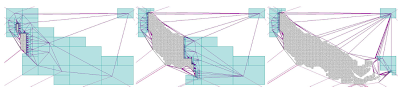
I'm quite interested in this, because here at Refractions I've just finished working on a project which involved computing a TIN for the province of B.C. using 500 million masspoints. After briefly flirting with the idea of computing a single seamless TIN, I ended up computing it in a piecewise fashion. This probably turned out to be a better approach for other reasons (such as the fact that we could easily parallelize the process). However, it would be very cool to be able to compute a seamless TIN for the entire province. And the approach in this paper sounds very effective - they quote a billion triangle in 48 minutes on a laptop!
It's also exciting to see the emergence of a whole new class of algorithms focussed on dealing with VLSD's (very large spatial datasets). As the same authors point out in another paper, paradoxically, advances in computing technology can make geospatial processing more difficult
because the rate of growth of dataset size far outstrips memory capacity.
Incidentally, these guys are a bit of a dream team for computational geometry algorithms. Shewchuck is the developer of Triangle, one of the best known programs for computing constrained 2D Delaunay triangulations (which is also AFAIK one of the few available systems to seriously address robustness issues - JTS of course being another one!) Snoeyink has done research in all kinds of different areas of CG, including interesting work in computing watershed boundaries on TINs using B.C. data.
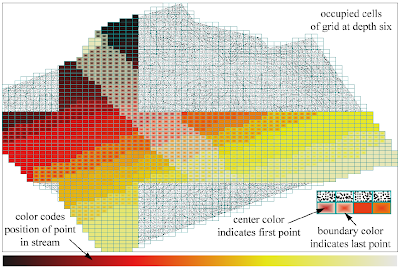
The paper also has a nice way of showing the spatial distribution of two related variables, using fill gradients:

I'm quite interested in this, because here at Refractions I've just finished working on a project which involved computing a TIN for the province of B.C. using 500 million masspoints. After briefly flirting with the idea of computing a single seamless TIN, I ended up computing it in a piecewise fashion. This probably turned out to be a better approach for other reasons (such as the fact that we could easily parallelize the process). However, it would be very cool to be able to compute a seamless TIN for the entire province. And the approach in this paper sounds very effective - they quote a billion triangle in 48 minutes on a laptop!
It's also exciting to see the emergence of a whole new class of algorithms focussed on dealing with VLSD's (very large spatial datasets). As the same authors point out in another paper, paradoxically, advances in computing technology can make geospatial processing more difficult
because the rate of growth of dataset size far outstrips memory capacity.
Incidentally, these guys are a bit of a dream team for computational geometry algorithms. Shewchuck is the developer of Triangle, one of the best known programs for computing constrained 2D Delaunay triangulations (which is also AFAIK one of the few available systems to seriously address robustness issues - JTS of course being another one!) Snoeyink has done research in all kinds of different areas of CG, including interesting work in computing watershed boundaries on TINs using B.C. data.
The paper also has a nice way of showing the spatial distribution of two related variables, using fill gradients:

Slow Forward - or back?
Here's an interesting take on the technological revolution by Gwynne Dyer (contrarian as always!). His point is that while life was dramatically transformed by numerous new technologies introduced between the 18th century and the 1950s, since then there's only really been one transformative technology, the computer (I guess he's discounting space travel since it's not generally available, or maybe because it's irrelevant?).
He has a good point, but I wonder whether he's ignoring quantitative effects of change. Sure, planes were around in the early 20th century, but they weren't allowing huge numbers of people to wash around the world in the way they do now. 9/11 would have been impossible in the 1920's, for instance. And maybe the steady improvments in speed of communication really will result in the so-called "inflection point".
But... in the end, he does mention what may turn out to be the most important quantitative effect of technological developments on humanity. His final point talks about the coming "... drastic changes in the climate that affect everything ...".
He has a good point, but I wonder whether he's ignoring quantitative effects of change. Sure, planes were around in the early 20th century, but they weren't allowing huge numbers of people to wash around the world in the way they do now. 9/11 would have been impossible in the 1920's, for instance. And maybe the steady improvments in speed of communication really will result in the so-called "inflection point".
But... in the end, he does mention what may turn out to be the most important quantitative effect of technological developments on humanity. His final point talks about the coming "... drastic changes in the climate that affect everything ...".
Tuesday, 14 August 2007
Engines of Logic
It seems only right that I put in a plug for the book Engines of Logic by the other, more famous Martin Davis. And here's an interesting article which reviews the book in particular reference to the occupational health hazards of being a mathematician. It's a good antidote to any regrets you might have about not being real smart.
Quote of the Day
If it wasn't for Alan Turing, I'd either be unemployed or working for the Nazis.
- unknown IT worker
- unknown IT worker
Monday, 13 August 2007
The Vietnam of Computer Science?
I couldn't resist the analogy of this blog article, even if the author slightly overstates the case. Good summary of the history of the war, too.
Makes me feel like if I haven't served a tour in the Delta, at least I've done time at a forward fire base...
Makes me feel like if I haven't served a tour in the Delta, at least I've done time at a forward fire base...
Friday, 10 August 2007
Complex Functions as Algorithmic Art
Hans Lundmark has an interesting page on visualizing complex functions. The idea is to map functions from f : C → C using position, hue, and saturation. The domain values of the function provide the (x, y) position. The function output value provides the hue and saturation; the hue is determined by the complex argument (angle), and the saturation is determined by the absolute value.
The output struck me as a nice example of algorithmic art. I whipped up my own version in Java to experiment, and to be able to produce high-resolution images for printing. Here's a couple of my images:
An example function from the paper ( f ( z ) = ( z − 2 )2 ( z + 1 − 2i ) ( z + 2 + 2i ) / z3 )
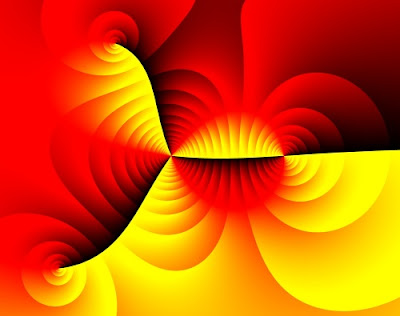
"Wild Walrus"
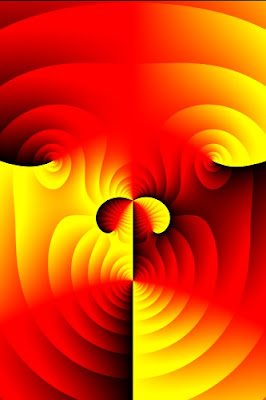
The output struck me as a nice example of algorithmic art. I whipped up my own version in Java to experiment, and to be able to produce high-resolution images for printing. Here's a couple of my images:
An example function from the paper ( f ( z ) = ( z − 2 )2 ( z + 1 − 2i ) ( z + 2 + 2i ) / z3 )

"Wild Walrus"

Wednesday, 8 August 2007
PreparedGeometry - efficient batch spatial operations for JTS
A common usage pattern for JTS spatial operations (in particular, predicates such as intersects and contains, and overlay operations such as intersection and union) involves the operation being invoked between a single target geometry and a batch of test geometries. For instance, this occurs in queries in a spatial database such as PostGIS, where each geometry in the driving table interacts with a set of nearby geometries via the required operation. By taking advantage of the fact that the target geometry does not change, it is possible to significantly reduce the overall execution cost of the operation. Information such as an index on the line segments in the target geometry can be computed once and cached for reuse with all of the test geometries.
In order for this to work, the calling code must be able to indicate that the operation is being invoked in a batch setting. The standard JTS Geometry API doesn't allow differentiating this case, so the new concept of PreparedGeometry has been developed. (This name intentionally echoes the concept of prepared statement in SQL API's, which implements the same strategy.) Creating a PreparedGeometry on a target Geometry enables precomputation of various data structures, which then allows subsequent operations to be evaluated with maximum efficiency.
In addition to caching, it is also possible to optimize the evaluation of spatial predicates. Optimization takes the form of short-circuiting predicate evaluation when certain situations are detected. While not all OGC spatial predicates are amenable to optimization, fortunately the most commonly usd predicates, intersects and contains, can be optimized significantly. Examples of situations which can be optimized are:
In order for this to work, the calling code must be able to indicate that the operation is being invoked in a batch setting. The standard JTS Geometry API doesn't allow differentiating this case, so the new concept of PreparedGeometry has been developed. (This name intentionally echoes the concept of prepared statement in SQL API's, which implements the same strategy.) Creating a PreparedGeometry on a target Geometry enables precomputation of various data structures, which then allows subsequent operations to be evaluated with maximum efficiency.
In addition to caching, it is also possible to optimize the evaluation of spatial predicates. Optimization takes the form of short-circuiting predicate evaluation when certain situations are detected. While not all OGC spatial predicates are amenable to optimization, fortunately the most commonly usd predicates, intersects and contains, can be optimized significantly. Examples of situations which can be optimized are:
- For intersects, any intersection between line segments indicates a true result. If there is no intersection between any line segments of the operands, and the target geometry is polygonal, then one or more fast point-in-polygon tests can be performed to compute the result value.
- Since it provides more information than intersects, the contains predicate is more complex to optimize. In the case where the target geometry is polygonal, evaluation can be short-circuited when the test geometry has no line segment intersection. In this case, containment can be tested by an appropriate set of point-in-polygon tests. It is also possible to short-circuit in some specific cases where a proper intersection is detected between two line segments. Both of these situations can be tested efficiently.
Saturday, 21 July 2007
Flex VS Silverlight - another shot in the war
Another interesting post by Kurt Cagle on The Open-Sourcing of FLEX (no, I'm not paid to shill for Kurt - even if we do live in the same town). I've been wondering how the Flash/Silverlight war was going to evolve, but I'd missed this turn of the strategy. Kurt has some interesting points:
- Open Source is a weapon to gain market share
- Does this promote the slow death of SVG? And will Mozilla team up with Adobe to promote Flex? (If so, maybe this answers the question about how the OS community will provide a story to reply to Silverlight)
- Does OS-ing Flex enhance Adobe's ability to improve the technology with feedback from OS adopters?
Friday, 20 July 2007
Where is XML going?
Kurt Cagle has an interesting post on "Where is XML going".
One of his bold predictions is that SQL databases (by which I think he means relational DBs) are going to plateau and slowly be replaced by XML-based DBs. I find that a fascinating possibility. Certainly the emergence of XQuery finally provides a decent query language for XML (and it's interesting to note that it draws from or at least parallels many SQL concepts).
One question I have is whether the XML information model is in fact more expressive than the relational model. It certainly seems so, since you can easily represent a table in XML, but the converse is not so simple. XML contains implicit information about hierarchy, which must be supplied in a relational model. It seems like there should be some sort of information content metric which could be used to determine which model is more powerful. Although, perhaps the human factors are in the end more important.
Also, to me it feels like XML suffers from too much concern with syntax (whereas relational is a pretty pure data model). There's also the cruft of elements versus attributes, processing instructions, etc. All of these complicate the XML model without bring a lot more data expressiveness. Perhaps simple use patterns will emerge and we'll all just get used to ignoring this stuff (but it seems to me that's been said about SOAP as well, and look how successful that's been...)
One of his bold predictions is that SQL databases (by which I think he means relational DBs) are going to plateau and slowly be replaced by XML-based DBs. I find that a fascinating possibility. Certainly the emergence of XQuery finally provides a decent query language for XML (and it's interesting to note that it draws from or at least parallels many SQL concepts).
One question I have is whether the XML information model is in fact more expressive than the relational model. It certainly seems so, since you can easily represent a table in XML, but the converse is not so simple. XML contains implicit information about hierarchy, which must be supplied in a relational model. It seems like there should be some sort of information content metric which could be used to determine which model is more powerful. Although, perhaps the human factors are in the end more important.
Also, to me it feels like XML suffers from too much concern with syntax (whereas relational is a pretty pure data model). There's also the cruft of elements versus attributes, processing instructions, etc. All of these complicate the XML model without bring a lot more data expressiveness. Perhaps simple use patterns will emerge and we'll all just get used to ignoring this stuff (but it seems to me that's been said about SOAP as well, and look how successful that's been...)
Wednesday, 18 July 2007
Do mountains exist?
I came across this provocatively-titled paper while web-surfing looking for information on ontology. It's a fun read, if you're into that kind of stuff. I don't think the paper really tackles its proposed thesis in a head-on way, but it does raise some interesting points about the philosophy of geospatial data, such as:
- What is the real definition of a mountain? Sure, we all know one when we see one - or do we? Go ahead - try and define this concept in a rigourous way...
- There is a long-standing schism between between feature-based and field-based views of natural phenomena. Both are useful, in different contexts. (This seems to me to echo the particle-wave duality of quantum mechanics - is there possibly some sort of fundamental dichotomy going on here?)
- Every so often this kind of debate surfaces in the geospatial world (a recent example is this thread on the GeoWeb blog). But we are as babes in the wood compared to philosophers, who have been debating this topic for at least 2000 years. Fortunately, it looks like the kindergarten of computer science is beginning to engage in a useful dialogue with the fusty temples of philosophy.
Thursday, 12 July 2007
The ultimate Point-In-Polygon implementation
The classic stabbing line/ray-crossing point-in-polygon algorithm has been around for longer than computational geometry itself. (See William Franklin and SoftSurfer for background and description. ) The algorithm as usually published is short, effective and clever. But it does have some limitations:
Most recently, I've revisited P-I-P in the course of some work on improving the performance of spatial predicates. And I think I've finally arrived at the ultimate Point-In-Polygon implementation. It removes all of the above limitations with the following design features:
Coming soon to a JTS version near you...
- It is implemented as an iteration over a data structure representing a sequence of line segments. This ties the algorithm to a fixed data structure, which leads to code duplication
- It handles simple rings, but not fully general polygons (which may contain holes and/or multiple shells)
- It does not detect the case where the query point lies on one of the segments in the polygon
- It runs in O(n) time. This is reasonable for a single query point, but is not the most efficient way to perform many point queries against a single fixed polygon
- It uses conventional floating-point arithmetic. This makes it non-robust (i.e. potentially incorrect for some inputs)
Most recently, I've revisited P-I-P in the course of some work on improving the performance of spatial predicates. And I think I've finally arrived at the ultimate Point-In-Polygon implementation. It removes all of the above limitations with the following design features:
- It uses an incremental design, which frees the algorithm from being tied to any particular segment data structure
- It handles all polygonal geometry types defined in JTS. (Implementing this was made much cleaner by the pleasant realization that the PIP algorithm really doesn't care where in a polygonal geometry the segments come from. The only thing that matters is the parity of the segment crossings. This holds true for any number of holes and shells.)
- It detcts the point-on-segment case, and reports it via a trivalent return value (in the set {INTERIOR, BOUNDARY, EXTERIOR}).
- It is straightforward to use with a spatial index on the segments of the polygon (such as STRtree or BinTree), thus providing O(log n) performance
- Thanks to the RobustDeterminant class in JTS, the implementation is much more robust. (Due to some remaining floating-point arithmetic it may still not be 100% robust - but I hope to address that sometime as well.)
Coming soon to a JTS version near you...
Monday, 9 July 2007
Relations - the machine code for data?
In the rushing torrent of computer science, a few concepts stand like rocks which resist being swept away. One of the most familiar and useful is relational database technology. It took a relatively short time for this concept to be identified (in Codd's paper of 1970) and implemented commercially (around 1975, in IBM's System R, among others). Perhaps only 10 or 15 years elapsed between the earliest database systems and the emergence of commercially viable RDBMS . For over 30 years since then RDBMS's have stood the test of time and repelled all challengers to their central role in data management.
A recent and serious challenger was Object database technology. In the 1990's this area looked poised to ride the gathering wave of object-oriented programming and sweep aside the fusty old RDBMS technology. Since then, while the OO wave has swept far up the beach, the promise of ODBMS seems to have been left behind in the receding foam, never having been fully realized.
So why is this?
I think one reason is that the relational paradigm could be a fundamental data structure for information representation. In a sense, relations are the machine code of data modelling - they can be used to represent any required data model. Granted, relational models aren't alway elegant or efficient - but that simply confirms the metaphor. Moreover, their simplicity allows relational theory to be firmly grounded in mathematics and logic. (Of course, the relational hard-cores have been saying this for years - in some cases a bit too vociferously, IMHO. I'm just reluctantly coming round to think that they might be right.)
A further piece of evidence for this observation is that RDBMS vendors have a fine track record of being able to adapt the core paradigm to accomodate new technical ideas. Queuing, security models, data analytics, and of course even (to an extent) object-orientation are some of the areas which have been implemented quite reasonably in terms of an underlying relational model.
ODBMS's, in contrast, have never quite seemed to develop a truly compelling and general paradigm. The various OO query languages don't seem to have the expressive power of SQL, and Object data models seem to run up against thorny semantic issues sooner than relational ones do (such as schema evolution and inheritance modelling). Granted, implementing an object-based data model using relational technology doesn't actually solve any of these issues, but somehow the maturity of relational techniques and tools make them seem less painful.
Some people (myself included) have tended to see the rise of Object-Relational mapping technology as at best a temporary expedient, and at worst a string-and-baling-wire solution to cope with the OO-RDB impedance mismatch. Just give ODB's a few more years to mature, we hope, and we can do away with this inelegant hack! But if relational really is a fundamental concept, perhaps the quest for pure OO databases is misguided. Perhaps O-R mapping tools are the final goal, not just a stop-gap. They can be thought of as compilers for the data access layer (with all the opportunity for performance improvement and platform independence that the compilation paradigm provides).
This isn't to say that RDB technology has evolved as far as it needs to. I hope to see much more powerful querying capability, using concepts from the areas of logic and functional programming, machine reasoning and knowledge representation. All of these seem to be continuing to mature - I look forward to seeing them make the leap to practicality like OO did years ago.
A recent and serious challenger was Object database technology. In the 1990's this area looked poised to ride the gathering wave of object-oriented programming and sweep aside the fusty old RDBMS technology. Since then, while the OO wave has swept far up the beach, the promise of ODBMS seems to have been left behind in the receding foam, never having been fully realized.
So why is this?
I think one reason is that the relational paradigm could be a fundamental data structure for information representation. In a sense, relations are the machine code of data modelling - they can be used to represent any required data model. Granted, relational models aren't alway elegant or efficient - but that simply confirms the metaphor. Moreover, their simplicity allows relational theory to be firmly grounded in mathematics and logic. (Of course, the relational hard-cores have been saying this for years - in some cases a bit too vociferously, IMHO. I'm just reluctantly coming round to think that they might be right.)
A further piece of evidence for this observation is that RDBMS vendors have a fine track record of being able to adapt the core paradigm to accomodate new technical ideas. Queuing, security models, data analytics, and of course even (to an extent) object-orientation are some of the areas which have been implemented quite reasonably in terms of an underlying relational model.
ODBMS's, in contrast, have never quite seemed to develop a truly compelling and general paradigm. The various OO query languages don't seem to have the expressive power of SQL, and Object data models seem to run up against thorny semantic issues sooner than relational ones do (such as schema evolution and inheritance modelling). Granted, implementing an object-based data model using relational technology doesn't actually solve any of these issues, but somehow the maturity of relational techniques and tools make them seem less painful.
Some people (myself included) have tended to see the rise of Object-Relational mapping technology as at best a temporary expedient, and at worst a string-and-baling-wire solution to cope with the OO-RDB impedance mismatch. Just give ODB's a few more years to mature, we hope, and we can do away with this inelegant hack! But if relational really is a fundamental concept, perhaps the quest for pure OO databases is misguided. Perhaps O-R mapping tools are the final goal, not just a stop-gap. They can be thought of as compilers for the data access layer (with all the opportunity for performance improvement and platform independence that the compilation paradigm provides).
This isn't to say that RDB technology has evolved as far as it needs to. I hope to see much more powerful querying capability, using concepts from the areas of logic and functional programming, machine reasoning and knowledge representation. All of these seem to be continuing to mature - I look forward to seeing them make the leap to practicality like OO did years ago.
Subscribe to:
Posts (Atom)


